
- Expert Marine Solutions
Cathodic Protection Services
in Saudi Arabia
Cathodic protection keeps steel and reinforced concrete assets from losing strength in seawater, soil, splash zones, tank bottoms, and industrial service areas. We support CP surveys, system design, material supply, installation coordination, testing, commissioning, and monitoring for marine structures, steel piles, sheet piles, steel tanks, jetties, quay walls, terminals, and plant infrastructure across Saudi Arabia. Your project may need galvanic anodes, impressed current anodes, transformer rectifiers, reference electrodes, junction boxes, test stations, cable connections, continuity bonds, remote monitoring, or a full condition survey before any new system is designed. The right scope depends on the structure type, coating condition, electrolyte, exposure zone, current demand, design life, access, and the owner or consultant specification.
Cathodic Protection for Marine, Tank and Industrial Assets
Cathodic protection is used when steel is exposed to corrosion risk in water, soil, concrete, or process environments. In Saudi Arabia, this matters for coastal structures, ports, marinas, desalination support assets, oil and gas facilities, storage tanks, industrial plants, and infrastructure near the Red Sea or the Arabian Gulf. A CP system should not be selected from a product list alone. Steel area, coating breakdown, chloride exposure, resistivity, tidal range, submerged depth, current distribution, electrical continuity, design life, access for inspection, and testing points all affect the final design. We help you move from “there is corrosion” to a clear technical scope. That may include a CP condition survey, anode replacement plan, new galvanic system, impressed current system, material package, monitoring upgrade, or full design and installation support.
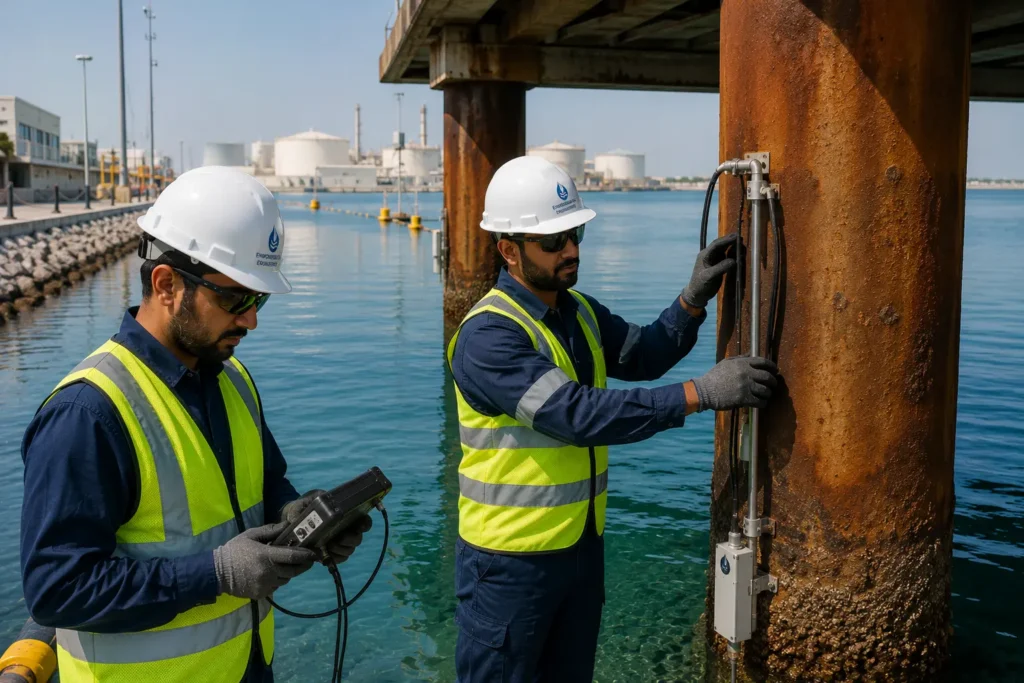
Our Cathodic Protection Services
Each structure has a different corrosion path. A reinforced concrete jetty does not behave like a buried tank bottom.
A steel pile in a splash zone does not need the same approach as an internal tank floor. Our CP services are
written around the actual asset, exposure condition, and maintenance goal.
Reinforced concrete in marine areas can suffer corrosion when chloride reaches the embedded steel. Cracking, rust staining, concrete spalling, delamination, and exposed rebar are common warning signs on jetties, piers, bridges, seawalls, and quay structures.
Steel piles face different exposure zones at the same time: atmospheric, splash, tidal, submerged, and buried mudline areas. The splash and tidal zones often need careful attention because coating damage and oxygen access can increase corrosion rates.
Sheet piles protect quay walls, retaining walls, berths, seawalls, and marine edges. Corrosion can reduce section thickness, weaken interlocks, and increase repair costs when the wall is part of an active port or industrial facility.
Marine steel structures include ladders, fenders, dolphins, platforms, pontoons, piles, beams, gates, guide frames, offshore components, and waterfront support steel. These assets often work in harsh exposure conditions with salt, waves, abrasion, coating damage, and limited access.
Steel tanks can corrode from the outside at the soil-side bottom or from the inside due to stored water, product interface, deposits, or aggressive service conditions. Tank bottom corrosion can stay hidden until inspection or leakage risk becomes serious.
An existing CP system may look complete but still fail to protect the structure. Common issues include consumed anodes, damaged cables, poor electrical continuity, wrong current output, failed junction boxes, incorrect rectifier settings, missing test data, or monitoring points that no longer work.
CP design starts with the asset and the exposure environment. The design should consider bare steel area, coating breakdown factor, design life, anode type, current density, water or soil resistivity, anode consumption, cable sizing, electrical continuity, safety, access, and monitoring needs.
Material quality affects CP performance. A weak cable connection, wrong anode alloy, poor junction box, undersized transformer rectifier, or missing test station can reduce protection and make troubleshooting difficult.
Remote monitoring helps owners track CP performance without waiting for manual site checks. It is useful for critical tanks, ports, marine terminals, industrial plants, and assets where access is difficult or downtime is costly.
Survey, Design, Supply and Commissioning in One CP Scope
Good cathodic protection work starts before installation. You need to know what is exposed, what is coated, what is electrically continuous, what is already damaged, and what the structure needs over its intended service life. We help connect the survey data with the design and material package. This reduces the risk of installing anodes in the wrong places, missing isolated steel sections, undersizing equipment, or handing over a system that cannot be tested properly.
- Condition survey and CP performance review
- Structure-to-electrolyte potential readings
- Electrical continuity and isolation checks
- Current demand and anode life calculations
- Galvanic and impressed current CP design
- Material supply and technical documentation
- Testing, commissioning, and handover support
- Remote monitoring and maintenance planning
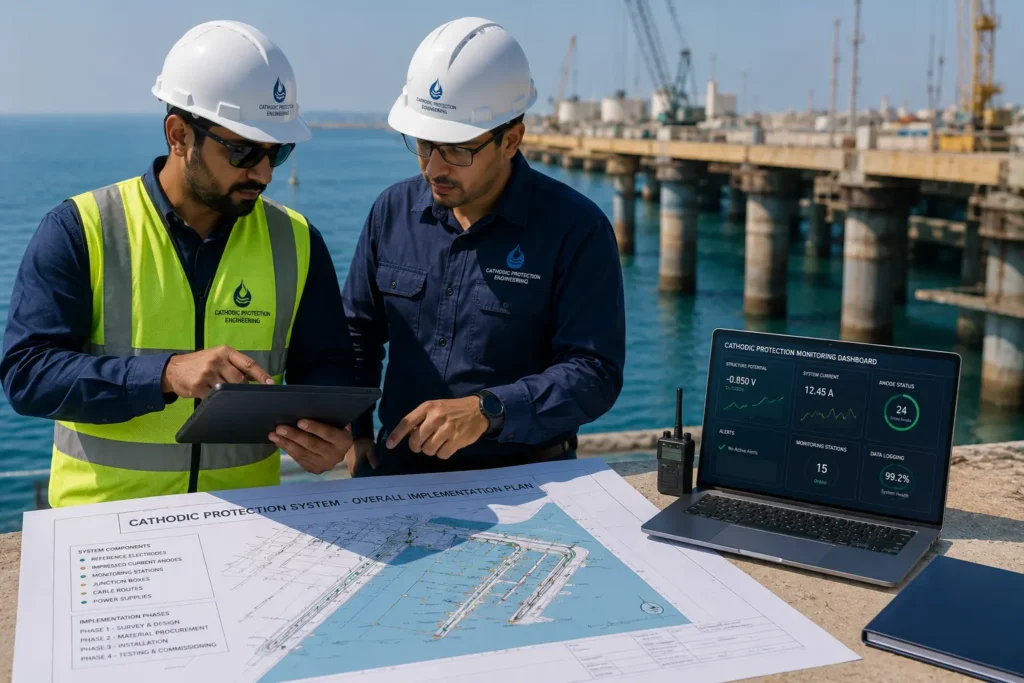
Galvanic Anode and Impressed Current CP Systems
Galvanic cathodic protection uses sacrificial anodes, such as aluminum or zinc, that corrode instead of the protected steel. This approach is common for many marine steel structures, piles, small tanks, and assets where a simple power-free system is suitable. Impressed current cathodic protection uses a DC power source, transformer rectifier, cables, and impressed current anodes. It is often used where the structure is large, the current demand is high, the design life is long, or monitoring and current adjustment are required.
- Drawings, dimensions, and structure type
- Steel grade, coating details, and repair history
- Seawater, soil, or tank service environment
- Existing CP drawings, rectifier records, or survey data
- Required design life and owner specifications
- Access limits, shutdown limits, and safety requirements
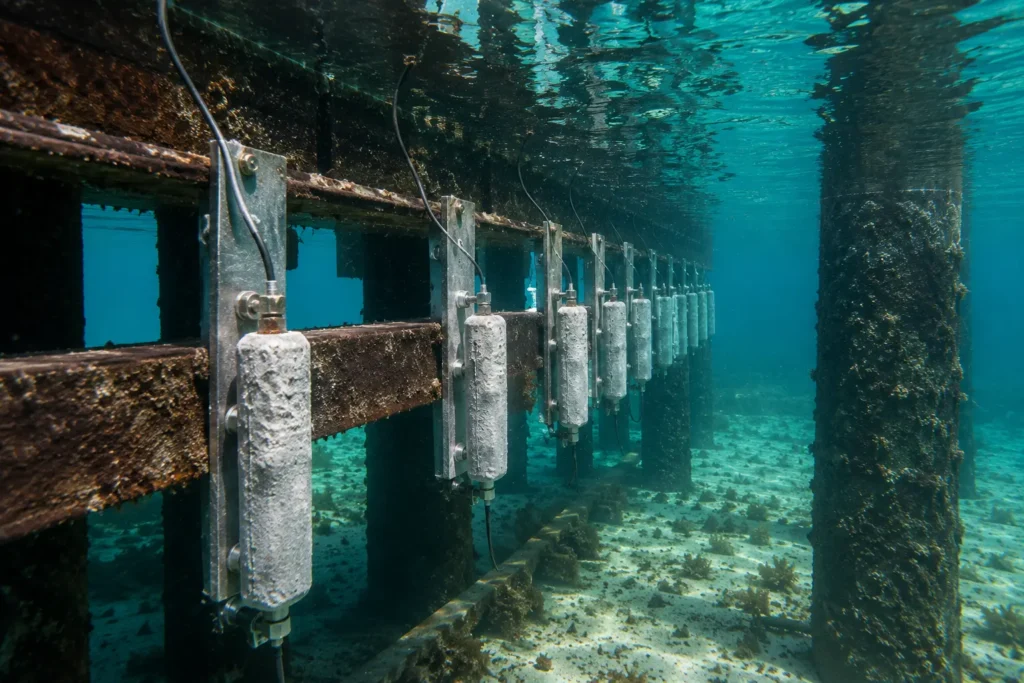
Why Cathodic Protection Matters
in Saudi Arabia
Saudi Arabia has major marine, industrial, oil and gas, logistics, and waterfront assets across the Red Sea and the Arabian Gulf. Ports, terminals, jetties, marine piles, sheet pile walls, tanks, pipelines, and plant structures are exposed to salt, heat, moisture, soil conditions, process fluids, and mechanical damage. Without the right corrosion control plan, steel loss can reduce design capacity, shorten asset life, create safety risk, increase shutdown time, and push repairs into emergency budgets. Cathodic protection helps control that risk when it is designed, installed, tested, and maintained correctly.
Structures and Projects We Support
Our cathodic protection work can support both new construction and existing assets. For new projects, CP should be reviewed early so anodes, cable routes, junction boxes, test stations, and access points are built into the work. For existing assets, the first step is usually a survey and a clear repair or retrofit plan.
Reinforced concrete jetties, piers, decks, and quay structures
Steel piles, dolphins, mooring structures, and marine platforms
Sheet pile walls, retaining structures, seawalls, and berth faces
Marine steel frames, ladders, fenders, guide piles, and pontoons
Aboveground and underground steel tanks
Internal and external tank bottom CP systems
Industrial plants, terminals, ports, marinas, and waterfront projects
Existing CP audits, retrofit works, and replacement material packages
Service Areas Across Saudi Arabia
We support cathodic protection projects across Saudi Arabia, including coastal, marine, industrial, energy, and infrastructure sites. Coverage can include Red Sea ports, Arabian Gulf ports, industrial cities, tank farms, waterfront developments, and inland facilities that need tank or buried steel protection.
Jeddah
Dammam
Al Khobar
Yanbu
Jazan
Tabuk
Red Sea coast
Eastern Province
NEOM region and northwest coast project areas
Other coastal and waterfront locations in Saudi Arabia
What is cathodic protection?
Cathodic protection is a corrosion control method that reduces metal loss by making the protected steel act as the cathode in an electrochemical cell. It can use sacrificial anodes or an impressed current system.
Which cathodic protection system is better: galvanic or impressed current?
Neither system is always better. Galvanic systems are often simple and power-free. Impressed current systems suit larger structures, higher current demand, adjustable output, and remote monitoring. The right choice depends on the structure, exposure, design life, and owner specification.
Can cathodic protection be used for reinforced concrete marine structures?
Yes. Cathodic protection can help reduce corrosion activity in embedded steel reinforcement when concrete is exposed to chloride and marine conditions. A survey is needed to confirm condition, continuity, concrete damage, and practical installation options.
Do steel piles and sheet piles need cathodic protection?
Steel piles and sheet piles often need corrosion control when they are exposed to seawater, tidal zones, splash zones, mudline areas, or aggressive soils. CP can be used with coatings and regular inspections to extend service life.
Can you provide cathodic protection for steel tanks?
Yes. Steel tanks may need external CP for soil-side tank bottoms or internal CP where the stored environment creates corrosion risk. The scope depends on tank type, lining, foundation, service condition, inspection data, and applicable project requirements.
What materials are used in a CP system?
Common CP materials include aluminum anodes, zinc anodes, impressed current anodes, transformer rectifiers, reference electrodes, cables, junction boxes, test stations, monitoring devices, cable glands, and continuity bonding materials.
How do you check if an existing CP system is working?
A CP system can be checked through potential measurements, rectifier output review, anode condition inspection, electrical continuity checks, test station readings, cable inspection, and comparison against the project acceptance criteria.
Do you support CP projects across Saudi Arabia?
Yes. CP support can be provided across Saudi Arabia, including Jeddah, Riyadh, Dammam, Al Khobar, Jubail, Yanbu, Jazan, Tabuk, Duba, Ras Al Khair, the Red Sea coast, the Eastern Province, and the Arabian Gulf coast.
Cathodic Protection FAQs
Start Your Cathodic Protection Project
With a Clear Technical Scope
Send your full cathodic protection works in Saudi Arabia.